







Economist Gift Mugano says Zimbabwe’s economic stability is entering a new phase, with the country’s surge in export earnings creating an opportunity to move beyond macroeconomic stabilisation towards improvements in health, education and living standards.
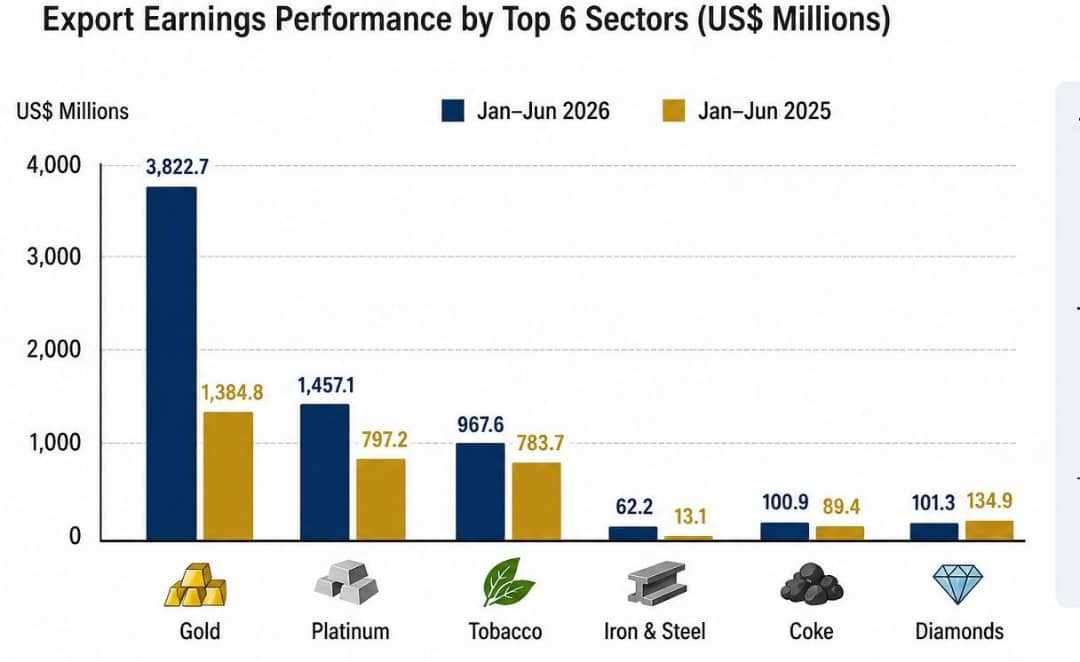
Mugano made the assessment after Reserve Bank of Zimbabwe figures showed that export earnings surged 90.7% to US$7.53 billion in the first half of 2026, from US$3.95 billion during the same period last year.
“This is phenomenal and unprecedented!” Mugano said. “This is why I argue that the economic stability you are seeing today is a permanent thing — it’s going nowhere!”
He said the immediate policy challenge was now to ensure that the stronger external position translated into broader social and economic gains.
“We now need to move from stability to inclusive development by improving access to health and education. It is possible because stability is a priority requirement for inclusive development!” he said.
The export figures provide the economic backdrop to his optimism, although they also reveal the extent to which Zimbabwe’s improved foreign-currency position remains dependent on commodities.
Mining accounted for US$6.21 billion of the US$7.53 billion earned during the six months, meaning the sector generated about 82% of total export receipts. Gold was the biggest contributor, with earnings rising 176% to US$3.82 billion, while platinum exports increased 82.8% to US$1.46 billion.
Related Stories
The concentration becomes even clearer when gold is isolated: the metal alone generated roughly half of Zimbabwe’s total export earnings during the period.
Tobacco, the country’s other major export earner, generated US$967.6 million, up 23.5% from the first half of 2025.
The figures suggest that Zimbabwe has significantly strengthened its capacity to generate foreign currency, but they also expose the challenge facing policymakers if the current stability is to become durable in a broader economic sense.
Much of the improvement is being driven by mining, with gold benefiting from both strong international prices and increased production. This leaves export performance vulnerable to movements in global commodity prices and reinforces the need to use the current inflows to build productive capacity outside the extractive sector.
Mugano’s call to shift towards inclusive development, therefore, places the emphasis on what Zimbabwe does with the increased export receipts rather than simply the size of the receipts themselves.
The opportunity is significant. Sustained foreign-currency inflows can support investment in electricity, transport, healthcare, education, agriculture and manufacturing, while stronger domestic production could reduce the economy’s dependence on imported goods.
The danger is that a commodity-led export boom could improve the country’s external accounts without producing a comparable improvement in household welfare.







Leave Comments